|
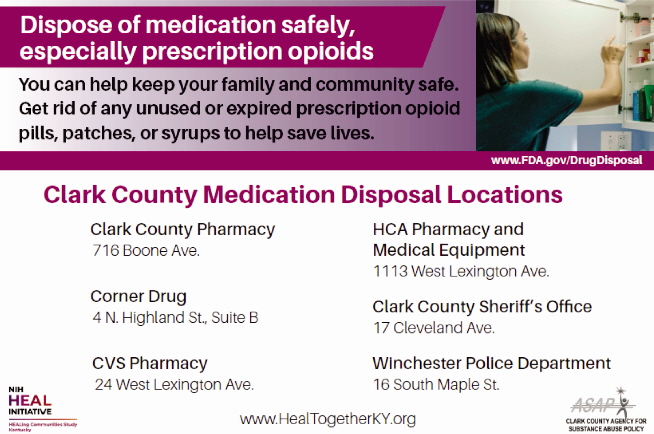
Local law enforcement will collect the unwanted medications and dispose of them properly, which keeps the medications out of our water supply and out of the hands of our children.
Frequently Asked Questions
Who is in charge of the Clark County Drug Disposal Program?
The Clark County KY Agency for Substance Abuse Policy is partnering with the Clark County Sheriff Department and Winchester Police Department to implement this program.
- For additional information about the program contact a local law enforcement agency.
What can I put in the drop box?
Accepted Items:
- Prescription Medications (please black out contact information)
- Over-the-counter Medications
- Pet Medications
- Medicated Ointments, Lotions and Creams
- Liquid Medication in Plastic Containers
- Vitamins
- Inhalers
NOT Accepted Items:
- Needles & Syringes (these items must be given to an officer)
- Thermometers
- Aerosol Cans
- Medication waste items such as: IV Bags, Used Bandages, Empty Containers
- Chemicals or disinfectants such as: Hydrogen Peroxide
- Personal Care Products
How will this help my community?
- Serious safety concerns have arisen regarding issues of accidental poisonings, drug diversion by teens, and environmental risks posed by keeping unused medication in the home. These concerns have prompted our community to implement a permanent drug disposal program.
- Unused medication in the household contributes to the growing rate of prescription drug abuse among Americans, particularly teenagers. The medicine cabinets of friends and family provide a steady supply of medications to inquisitive teens.
- Every day 2,500 youth age 12 to 17 abuse a pain reliever for the very first time.1
- More teens abuse prescription drugs than any illicit drug except marijuana. 1
- In 2008, more than 2.1 million teens ages 12 to 17 reported abusing prescription drugs.1
- Among 12- and 13-year-olds, prescription drugs are the drug of choice.2
- Because these medications are so available and because so many teens and parents erroneously believe that they are safer to misuse than illegal street drugs, teens who wouldn’t normally “use drugs” might abuse prescription drugs.
- The goal of the Clark County Drug Disposal Program is to significantly reduce the diversion of controlled and over-the-counter medications through proper disposal practices and community awareness.3
What can I do with my medications if I can’t go to the drug drop box locations?
Why can’t I flush them down the toilet?
- Medicines flushed down the toilet go to one of two places: septic tanks or through sanitary sewers and into wastewater treatment plants which may not fully or effectively remove all of the pharmaceutical waste. These small amounts of pharmaceutical wastes can get back into the environment. Very low levels of pharmaceuticals can be found in our lakes, streams and rivers.
- Researchers are trying to determine:
- Whether these levels affect the fish and wildlife that use the waterways;
- Whether these chemicals end up back in the water we drink; and if so
- Whether the very low levels detected pose a health risk to people.
- Additional information about this issue can be found on the following websites:
_________________________________________________________________________
- Substance Abuse and Mental Health Services Administration (SAMHSA). (2009)
National Survey on Drug Use and Health, 2008
- Ibid
- National Association of Drug Diversion Investigators
|